Tactx

Posted

29 May 15:27

We could have talked all day!

There's a 90-minute video to digest as we Talk Everything Football with Jon Mackenzie ahead of his new book release, The Spectre of Pep. 

A huge thanks to Jon for joining and for the questions. Unfortunately, we couldn't cover every question, so we have added Jon's response to the ones we couldn't answer. 

01:28:12

TALKING EVERYTHING FOOTBALL...

Jon dropped into our live webinar to discuss the release of...

One thing I didn't mention is that Domenec Torrent's definition literally includes the concept of relation within it: PP is positioning your players RELATIVE to everyone on the pitch to generate advantages. Where Guardiola and Diniz differ is in conceiving of how you structure these relationships - not in one disregarding relationships altogether.

It's worth remembering that all relationships on a football pitch are impossible without a concept of position. In that respect, relationism HAS to be positional.

They can still have their own unique existence. But they are still a subset, in my opinion, of a broader category: positional play.

By suggesting PP as a more general term is "useless", it seems as though you're saying "well we still have to differentiate between Guardiola and Diniz!" - absolutely! But the differentiator isn't PP - it's the way that these two coaches are using positional ideas in very different ways.

4)"If you define positional play as being all football it's a useless term. Hybrid play can also be some players have rigid positions and some are floaters. It's not only spoken about in relation to phases."

I completely disagree with this. My argument is that by restricting PP down to "what Guardiola does tactically" is unhelpful. Guardiola uses PP as a tool to achieve what he wants to strategically on a football pitch. In that sense, Guardiola's football and positional play are in different categories entirely. PP is basically a higher category of thing: like "animals" is to "dogs". The category "animals" is useful because it explains to us what kind of things "dogs" are. But it doesn't mean we then collapse "dogs" into other species of animal. "Dogs" and "spiders" are very different things but they are still animals. In the same way, Guardiola's football is very different from Fernando Diniz's football. 

3)"Could the rise in more chaos lead to the decline in so called specialist and instead lead to the Ascension in clubs recruiting and platforming more generalists"

Yes! I think this is exactly what we could see happening. The game will become less controllable and so rather than optimising for a one-size-fits-all approach (which is what Guardiola was able to do in many respects) it has to be much more ad hoc. This makes generalists far more valuable than in the past.

BUT if your attack breaks down and you recycle, you have more scope to generate space + time in your back line. So you can fall back into the older system of working an opponent deep into their own box in a low block.

The problem is, teams are optimising for more direct play and so we're seeing squads less optimised for low block breaking (and the risk is that destabilising a block through positional rotations leaves you susceptible to counter attacks). So what we're seeing control teams doing more of now is drawing out oppo blocks to play more transitional.

So - roundabout answer - I think possession control now has to be much less uniform than it used to be (unsettled poss--->settled poss---> sustainable progression---> final third) and more more tempo shifted (unsettled poss--->direct progression--->final third--->recycle to decompress block---> direct progression---->repeat).

Hope that explains things?

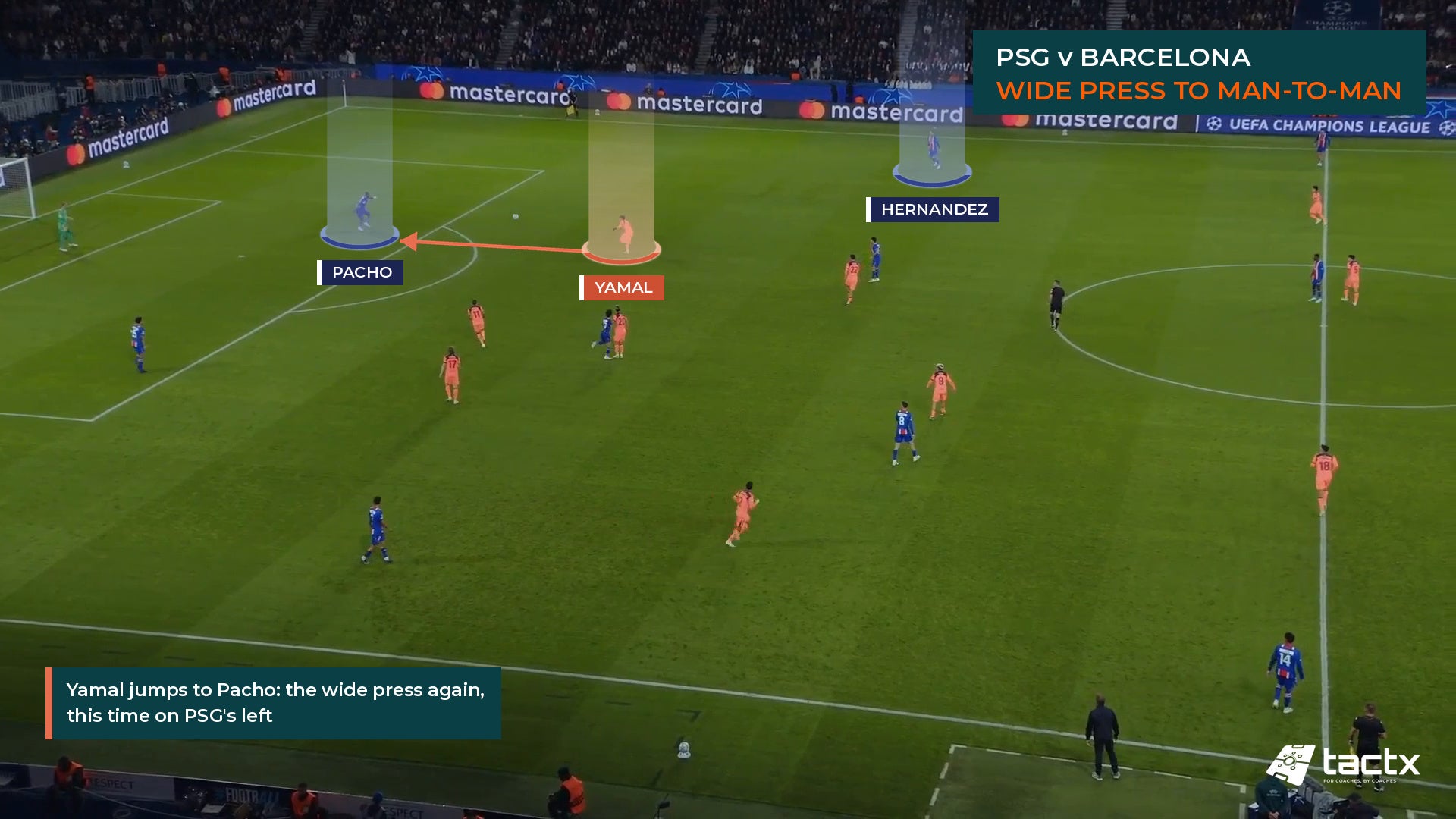
As for how you can achieve this control, for me, it's more about how you reorganised settled possession (space + time) and unsettled possession (no space and so no time). Where in the past, you would work unsettled possession from GKs into settled possession in your back line, m2m means many teams simply don't allow you space + time in your back line in these scenarios and so the space has opened out in behind presses. This speeds up play: you play through or over presses into this space and then tempo shift into more direct attacks.

2)"The current Premier League tactical landscape has shifted to one that's more intense, physical, and vertical. If a coach was to try and establish a more control oriented approach (Alonso/Maresca), what are the challenges they face and how could they overcome it?"

The million dollar Q. I think control now has to be structured around timing more than ever rather than simply through manipulation of space. That's a given in a world where m2m becomes key because the tradeoff is essentially a battle between allowing space and not allowing space - allowing space gives time, refusing space takes away time.

Questions and answers from Jon that we couldn't fit into the webinar...

1)"Do you think a misconception of Positional play is that it aims to control through possession where primarily control in football is actually control of space which Positional play tries to optimise"

I agree that people tend to downplay space in the modern discourse. Football is always about controlling space in some sense - there is no football that isn't spatial. But as I said, I think the pos/rel debate is set up as a dichotomy between "space" and "relation" when really the point that the relationists should be making is that they take a very different view of the relationships between players than other coaches. Both Guardiola and Diniz (to use a concrete example) care about space and the relations between their players. But they conceive of them very differently.

Posted

28 May 14:19

1 / 2
2 / 2

Coaching a team to remain compact.

You will hear the word 'compact' a lot from commentators and coaches, but how do you actually coach it? 

The latest Michael Carrick practice session shows an 11v11 game with channels to help players maintain the correct distances. 

Available for all subscribers.

https://tactxcoach.com/programs/carrick-collection